
Prairie Wildlife Research Habitat & Species
Protecting Prairie Ecosystems and the Wildlife Within
Habitat & Species of the Great Plains
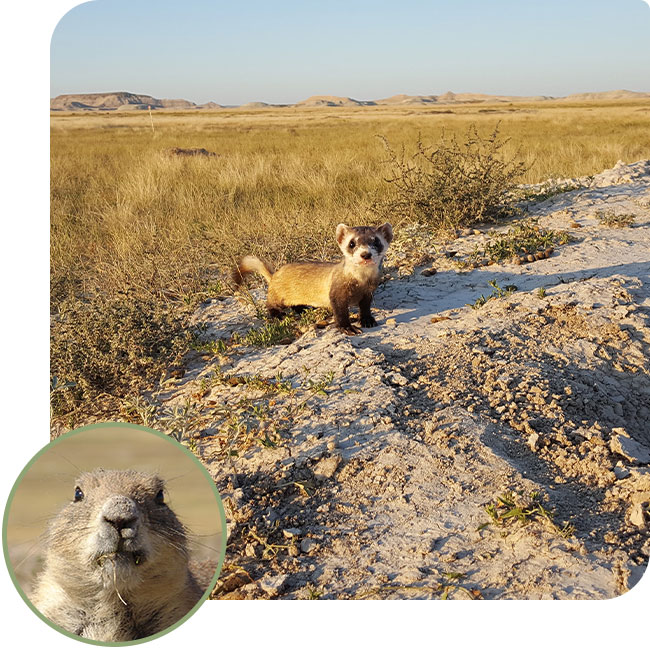
Discover the unique prairie ecosystem and the species that call it home, including the endangered black-footed ferret and black-tailed prairie dog. Learn how Prairie Wildlife Research works to conserve these animals and their habitat through science, outreach, and collaboration.
Support Conservation, Protect Wildlife
Prairie Wildlife Research
Black-Footed Ferret
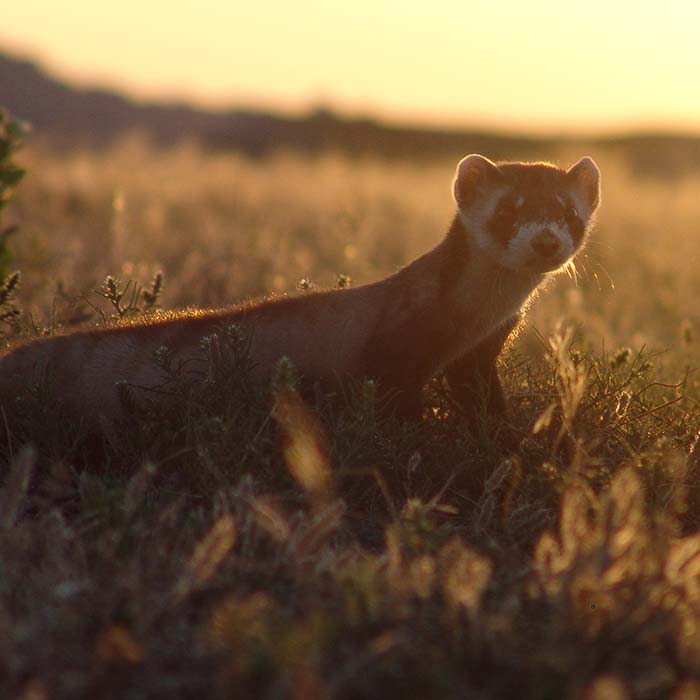
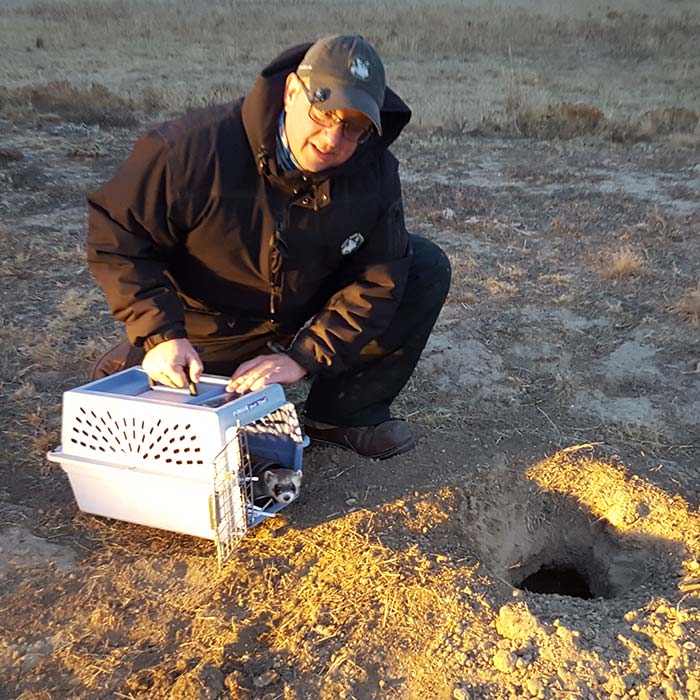
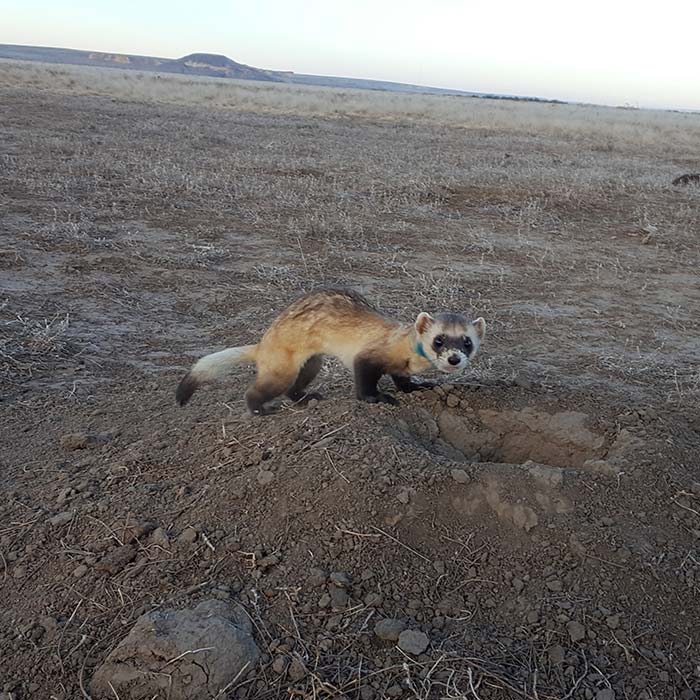
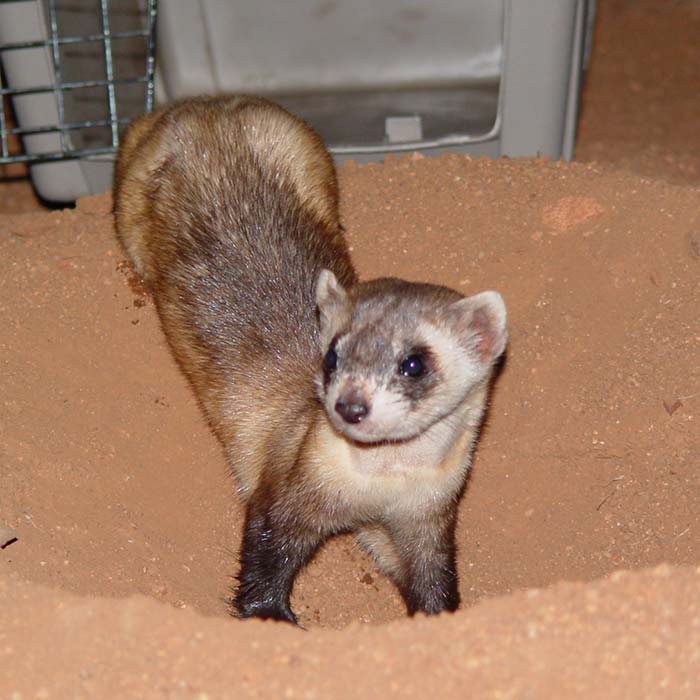
An endangered predator relying on prairie dogs for food and shelter, native to North America's grasslands.
Common Name:
Black-Footed Ferret
Scientific Name:
Mustela Nigripes
Other Names:
Pispiza Itopta Sapa, Black-Faced Prairie Dog, The American Ferret, Putorius Nigripes
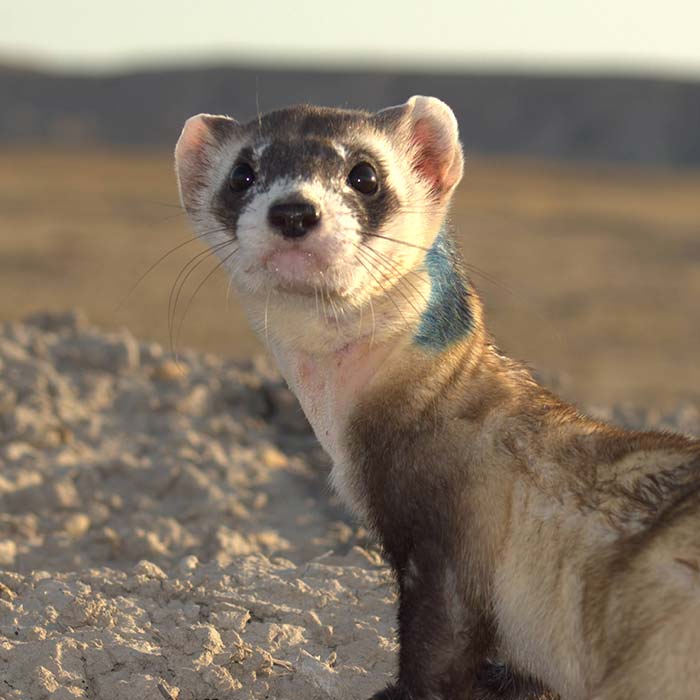
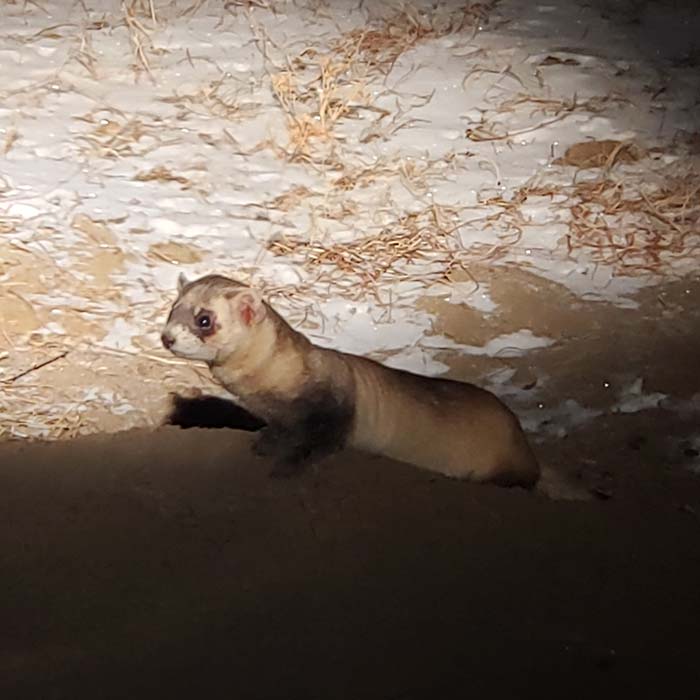
Fur is buff/tan on the body with some black-tipped hairs along the back, lighter color on the underside. Black feet and legs, face mask and tail tip. Fur length approximately 0.4 inches (1 cm). Body length of adult and juvenile females in autumn 14 ½ - 17 inches (35-43 cm) averaging 15 ½ inches (39 ½ cm) plus a 4 ½ inch (12 cm) tail. Average female weight in autumn is 1.6 lbs. (730 g). Males larger than females with adult males measuring 16-17 ½ inches (41-45 cm) long, averaging 17 inches (43.2 cm) plus a 5 inch (13 cm) tail in autumn. Average adult male weight in autumn is 2.4 lbs. (1,095 g). Juvenile males measure 14 ½ - 18 inches (37-45 ½ cm) long, averaging 16 ½ inches (41.8 cm) in autumn plus a 5 inch (13 cm) tail. Juvenile male weight in autumn averages 2 lbs. (933 g).
Black-tailed prairie dog colonies, white-tailed prairie dog colonies, Gunnison’s prairie dog colonies. Black-footed ferrets are found surviving only on prairie dog colonies.
Prairie dogs make up more than 90% of their diet. The remaining portion is comprised of mice, voles, rabbits and small birds. Predation upon prairie dogs takes place below ground at night typically while prairie dogs are sleeping. Occasionally black-footed ferret use ambush hunting techniques near sunrise to capture a prairie dog as it emerges from the burrow.
Breeding season begins in late March and continues through April. Territorial males will breed as many females as possible. Black-footed ferrets are induced ovulators. Gestation is 44 days and kits are born below ground completely altricial (blind, naked, helpless). Average litter size is 3 (range 1-6). Female nurses the kits until they emerge above ground for the first time, usually in July. After copulation the male has no role in raising the young. Kits are adult size by autumn and ready to breed at 10 months of age.
Black-footed ferrets are territorial and solitary with the exception of breeding season and litter rearing. Male home ranges average 132 acres (53 hectares) and generally overlap female home ranges that average 65 acres (26 hectares). Kits are adult sized by September (females) and November (males) and will disperse away from their mothers in September. Males typically disperse farther than females and also experience a higher mortality rate. Survival to 1 year is approximately 30% for males and 50% for females. Primary predators of black-footed ferrets include coyotes, badgers and great horned owls.
Black-footed ferrets are mostly nocturnal but occasionally are seen in the daylight. At night they bound between prairie dog burrows. Active year-round they leave a distinctive track in the snow that biologists can track. Frequently carry ticks (on the neck and head) and fleas (throughout the body but particularly the rump). Fleas are a vector of plague which is fatal to black-footed ferrets. Also susceptible to canine distemper.
Listed as endangered under the Endangered Species Act in the US and Mexico. Listed as extirpated in Canada under the Species at Risk Act (SARA). Prairie dog poisoning, land conversion to agriculture and plague reduced and fragmented prairie dog populations throughout the 20th Century. The first population ever studied was in Mellette County, South Dakota 1964-1974. Nine individuals captured for captive breeding but no live young were produced. The last captive black-footed ferret from Mellette County died in 1979 and the wild population was also gone. Biologists feared the species was extinct.
On September 26, 1981 a ranch dog near Meeteetse, Wyoming killed a black-footed ferret and brought it home to John and Lucille Hogg who took it into to taxidermist Larry LaFranchie who identified it as a black-footed ferret. A population was discovered and studied on white-tailed prairie dog colonies occupying private lands near Meeteetse. The population peaked at 129 individuals in 1984 but declined to 58 in 1985. Sylvatic plague and canine distemper were decimating the population and eventually the decision was made to capture some animals. Six were captured but died of canine distemper. The remaining wild black-footed ferrets were captured in the Fall of 1985 and Fall/Winter of 1986-87. A total of 18 were removed (11 females, 7 males) and formed the nucleus of a successful captive breeding program. By 1991 enough kits were produced in captivity that reintroductions back into the wild began and continue today. Black-footed ferrets have been reintroduced at more than 30 locations in 8 US States, Mexico and Canada. Future recovery of the species is completely dependent upon managing healthy prairie dog populations, requiring tools to mitigate plague and overcoming the negative social attitudes towards prairie dogs from the agricultural community.
Prairie Wildlife Research
Black-Tailed Prairie Dog
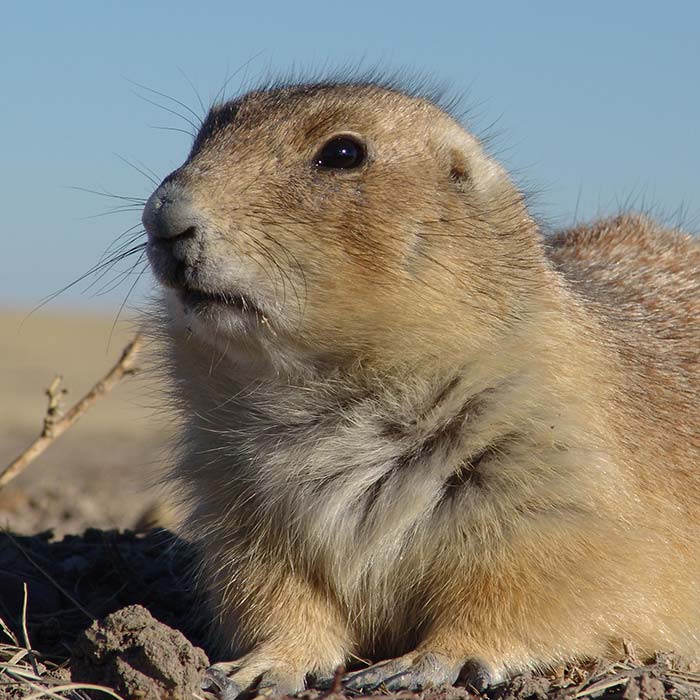
A keystone prairie species whose colonies support many animals, including the endangered black-footed ferret.
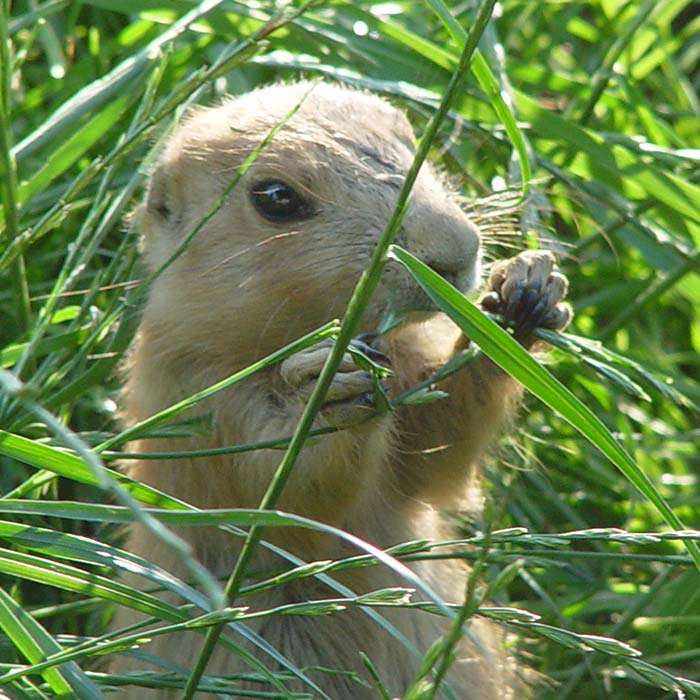
Common Name:
Black-Tailed Prairie Dog
Scientific Name:
Cynomys Ludovicianus
Other Names:
Petit Chien, Barking Ground Squirrel, Prairie Marmot, Prairie Squirrel, Pispiza
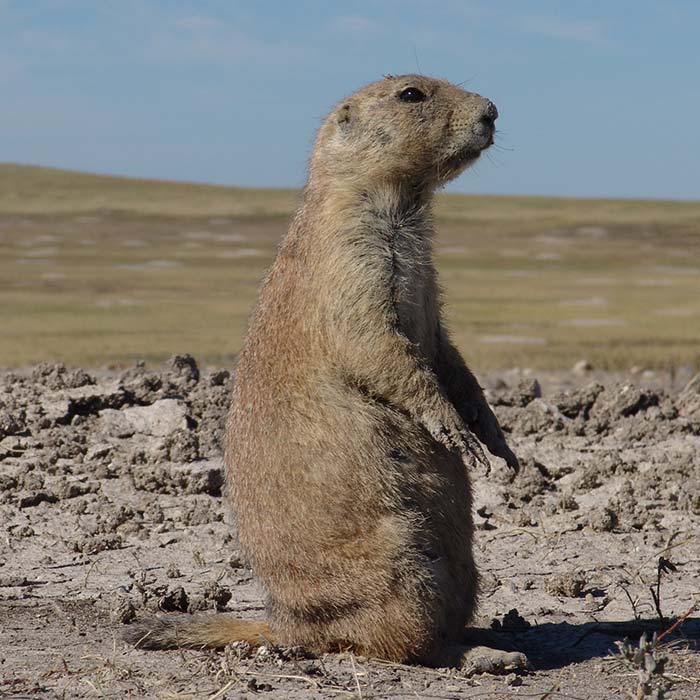
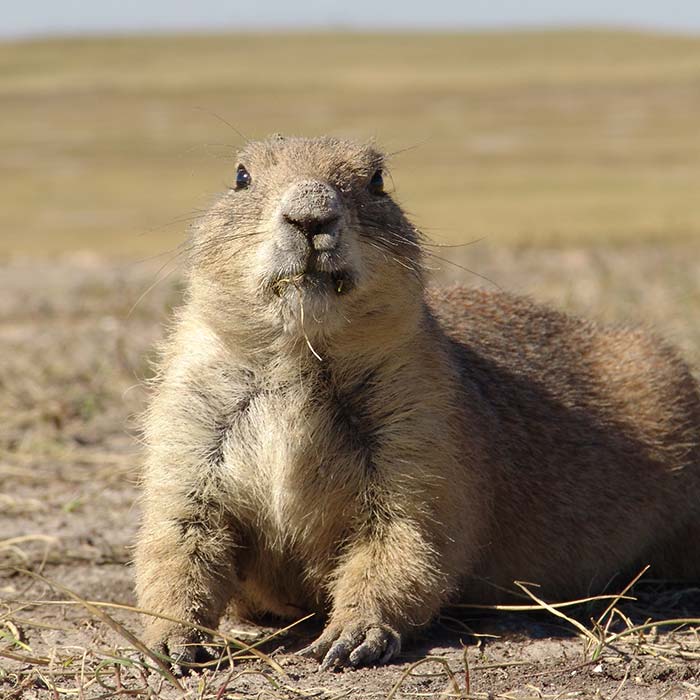
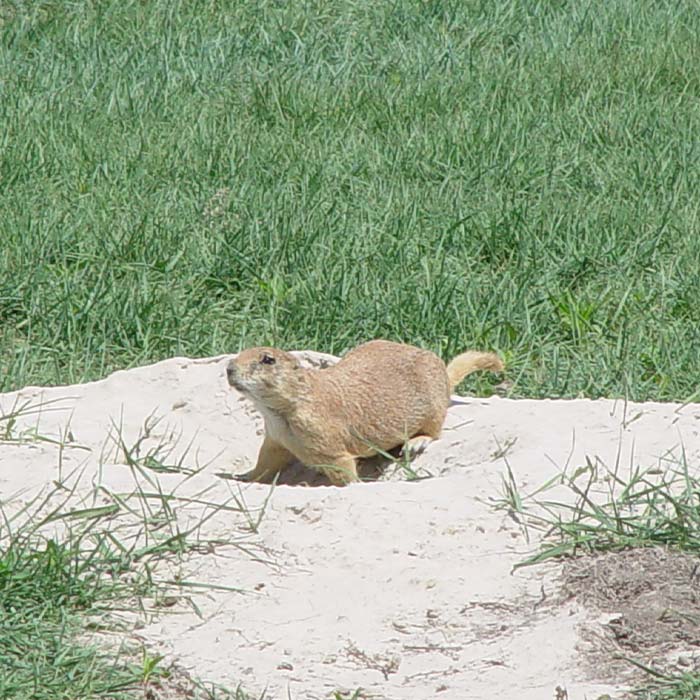
Reddish-brown fur throughout the body with lighter color on the underside. Last 1/3 of the tail is black.11-13 inches (28-33 cm) long plus a 3-4 inch (8-10 cm) tail. Males are generally larger than females. Black-tailed prairie dogs weigh 2-3 lbs. (900-1,360 g).
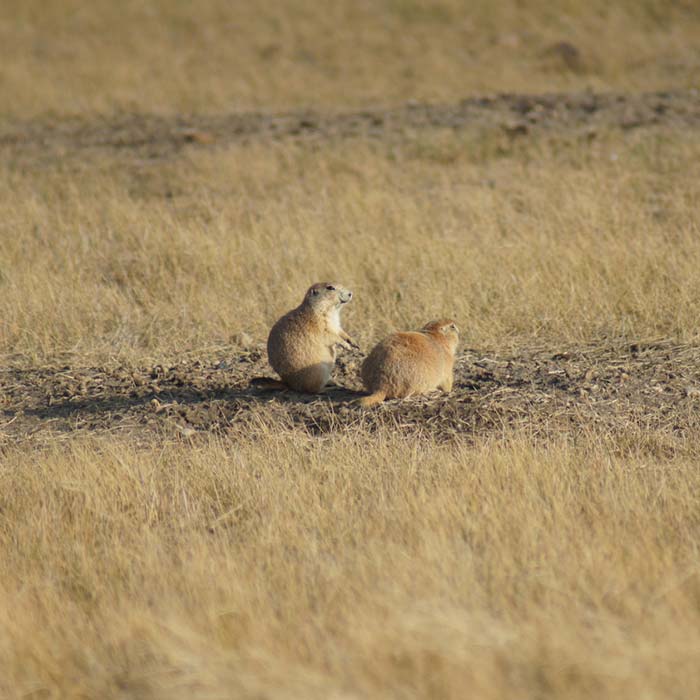
Prairies, grasslands and open areas with clay soils that can maintain a burrow system. Mostly level ground so they can see predators approaching.
Grass. Western wheatgrass, blue grama, buffalograss, scarlet globemallow.
Takes place below ground February-April, depending on latitude. Female is receptive for only a few hours one day per year. Gestation 34-35 days. Litter sizes can range from 1-6 pups (average 3). Mothers will lactate and nurse for 37-51 days. Juveniles will emerge above ground May-June and become mature at 2 years old. One litter per year.
Black-tailed prairie dogs are social and live together in large aggregations called colonies or towns. Within a colony a family unit of prairie dogs, known as a coterie, consists of 1 adult male, 2-3 adult females and all of their young less than 2 years old. Coteries can number 1-26 individuals (average 6) and occupy an area up to 2.5 acres (1 hectare) but typically average 1 acre (0.4 hectares) in size. Black-tailed prairie dogs defend the boundaries of the coterie from other prairie dogs and most coteries contain 70+ burrow entrances. Within the coterie prairie dogs will “kiss” (touch their front teeth together) to recognize their kin.
Prairie dogs are diurnal (active during the day) and spend most of their time feeding, maintaining burrows and clipping vegetation to see approaching predators (coyotes, hawks, badgers, eagles).The main sources of mortality are predation, infanticide (a female prairie dog killing another female prairie dogs pups), inability to survive winter and plague. Black-tailed prairie dogs can live as long as 5-8 years but on average live 2-5 years. Surviving the first year is difficult. Females typically spend their entire life in the coterie they were born whereas males will disperse away from their natal coterie.
When a potential predator approaches the colony prairie dogs will begin to “bark” an alarm call to alert other prairie dogs of the danger. Black-tailed prairie dogs have at least a dozen different vocalizations including the “jump-yip” where the prairie dog throws it’s front legs into the air and makes a “Whee-ooo” sound. Black-tailed prairie dogs typically do not hibernate but if conditions are extreme (drought, extreme cold, deep snow) they can go into hibernation (facultative torpor).
Black-tailed prairie dogs were poisoned, plowed over and shot throughout most of the 20th Century. Plague has also been a significant factor in prairie dog decline. At one time there was an estimated 79 million acres (32 million hectares) of black-tailed prairie dog colonies in North America. Today there are an estimated 2.4 million acres (983,000 hectares) occupied, a 97% reduction in the past 150 years.
Black-tailed prairie dogs were petitioned for listing under the Endangered Species Act in 1994 but not enough information was available and listing was denied in 1995. In 1998 they were again petitioned to be listed as threatened species and were placed on the candidate (should be listed but will not be because of higher priorities) list in 2000. In 2004 the black-tailed prairie dog was removed from the candidate list. The US Fish & Wildlife Service again evaluated black-tailed prairie dogs for listing in 2008 but denied listing in 2009. In some US States prairie dogs are managed to a certain degree but are listed as a pest in other states. Black-tailed prairie dogs were extirpated from Arizona by 1940 but recently Arizona has reintroduced populations. Some US States have state laws or local ordinances that nearly mandate the eradication of prairie dogs. In Canada black-tailed prairie dogs are listed as a species of Special Concern under the Species at Risk Act (SARA).
Today the primary threats to black-tailed prairie dogs are plague and negative public attitudes. Even on federal public lands it is difficult to maintain prairie dogs because of political pressure to poison from agricultural interests. Those prairie dogs that do remain are susceptible to plague.
Contact Us
If you have questions or would like to request Prairie Wildlife Research for a speaking engagement, please feel free to contact us.
Research-Driven Conservation for Lasting Impact
Research
Research is such an important part of wildlife conservation and endangered species recovery that we decided to incorporate it into our name, Prairie Wildlife Research. In order to conserve a species like the black-footed ferret we must truly understand it. We collaborate with many partners on research projects ranging from genetics to survival to stress and more. Below are some of our research publications. Please feel free to contact us with any questions about our research.
Eads, D. A., D. E. Biggins, S. M. Grassel, T. M. Livieri and D. S. Licht. 2016. Interactions among American badgers, black-footed ferrets, and prairie dogs in the grasslands of western North America. Pages 193-218 in G. Proulx, E. Do Linh San, editors. Badgers of the world: systematics, ecology, behaviour and conservation. Alpha Wildlife Research and Management, Alberta, Canada.
Eads, D. A., D. E. Biggins, and T. M. Livieri. 2015. Spatial and temporal use of a prairie dog colony by coyotes and rabbits: potential indirect effects on endangered black-footed ferrets. Journal of Zoology 296:146-152.
Eads, D. A., D. E. Biggins, T. M. Livieri and J. J. Millspaugh. 2014. Space use, resource selection and territoriality of black-footed ferrets: implications for reserve design. Wildlife Biology 20:27-36.
Harris, N. C., T. M. Livieri and R. R. Dunn. 2014. Ectoparasites in black-footed ferrets (Mustela nigripes) from the largest reintroduced population of the Conata Basin, South Dakota, USA. Journal of Wildlife Diseases 50:340-343.
Shoemaker, K. T., R. C. Lacy, M. L. Verant, B. W. Brook, T. M. Livieri, P. S. Miller, D. A. Fordham and H. R. Akcakaya. 2014. Effects of prey metapopulation structure on the viability of black-footed ferrets in plague-impacted landscapes: a metamodelling approach. Journal of Applied Ecology
Eads, D. A., D. E. Biggins, T. M. Livieri and J. J. Millspaugh. 2013. American badgers selectively excavate burrows in areas used by black-footed ferrets: implications for predator avoidance. Journal of Mammalogy 94:1364-1370.
Livieri, T. M., D. S. Licht, B. J. Moynahan and P. D. McMillan. 2013. Prairie dog aboveground aggressive behaviors towards black-footed ferrets. American Midland Naturalist 169:420-423. Videos can be seen here.
Livieri, T. M. and E. M. Anderson. 2012. Black-footed ferret home ranges in Conata Basin, South Dakota. Western North American Naturalist 72:196-205.
Santymire, R. M., S. M. Wisely, T. M. Livieri and J. Howard. 2012. A rapid method of age determination in the black-footed ferret. Small Carnivore Conservation 46:17-21.
Eads, D. A., D. E. Biggins, D. Marsh, J. J. Millspaugh and T. M. Livieri. 2012. Black-footed ferret digging activity in summer. Western North American Naturalist 72:140-147.
Eads, D. A., D. S. Jachowski, D. E. Biggins, T. M. Livieri, M. R. Matchett and J. J. Millspaugh. 2012. Resource selection models are useful in predicting fine-scale distributions of black-footed ferrets in prairie dog colonies. Western North American Naturalist 72: 206-215.
Livieri, T. M. 2011. Black-footed ferret recovery in North America. Pages 157-164 in . S. Soorae, editor. Global re-introduction perspectives: 2011. Additional case studies from around the globe. IUCN/SSC Re-introduction Specialist Group. [PDF]
Poessel, S. A., D. E. Biggins, R. M. Santymire, T. M. Livieri, K. R. Crooks and L.Angeloni. 2011. Environmental enrichment affects adrenocortical stress responses in the endangered black-footed ferret. General and Comparative Endocrinology 172:526-533. [PDF]
Biggins, D. E., T. M. Livieri and S. W. Breck. 2011. Interface between black-footed ferret research and operational conservation. Journal of Mammalogy 92:699-704.[PDF]
Biggins, D. E., J. L. Godbey, B. M. Horton and T. M. Livieri. 2011. Movements and survival of black-footed ferrets associated with an experimental translocation in South Dakota. Journal of Mammalogy 92:742-750. [PDF]
Cain, C. M., T. M. Livieri and B. J. Swanson. 2011. Genetic evaluation of a reintroduced population of black-footed ferrets (Mustela nigripes). Journal of Mammalogy 92:751-759. [PDF]
Poessel, S. A., S. W. Breck, D. E. Biggins, T. M. Livieri, K. R. Crooks and L. Angeloni. 2011. Landscape features influence postrelease predation on endangered black-footed ferrets. Journal of Mammalogy 92:732-741. [PDF]
Jachowski, D. S., J. J. Millspaugh, D. E. Biggins, T. M. Livieri, M. R. Matchett and C.D. Rittenhouse. 2011. Resource selection by black-footed ferrets in South Dakota and Montana. Natural Areas Journal 31:218-225. [PDF]
Eads, D. A., J. J. Millspaugh, D. E. Biggins, T. M. Livieri and D. S. Jachowski. 2011. Post-breeding resource selection by adult black-footed ferrets in the Conata Basin, South Dakota. Journal of Mammalogy 92:760-770. [PDF]
Eads, D. A., J. G. Chipault, D. E. Biggins, T. M. Livieri and J. J. Millspaugh. 2010. Nighttime aboveground movements by prairie dogs on colonies inhabited by black-footed ferrets. Western North American Naturalist 70:261-265. [PDF]
Eads, D. A., D. E. Biggins, D. S. Jachowski, T. M. Livieri, J. J. Millspaugh and M. Forsberg. 2010. Morning ambush attacks by black-footed ferrets on emerging prairie dogs. Ethology Ecology & Evolution 22:345-352. [PDF]
Jachowski, D. S., J. J. Millspaugh, D. E. Biggins, T. M. Livieri and M. R. Matchett. 2010. Home-range size and spatial organization of black-footed ferrets Mustela nigripes in South Dakota, USA. Wildlife Biology 16:66-76. [PDF]
Wisely, S. M., R. M. Santymire, T. M. Livieri, S. A. Mueting and J. Howard. 2008. Genotypic and phenotypic consequences of reintroduction history in the black-footed ferret (Mustela nigripes). Conservation Genetics 9:389-399. [PDF]
Livieri, T. M. 2007. Black-footed ferret spatial use of prairie dog colonies in South Dakota. M. S. Thesis, University of Wisconsin – Stevens Point, 72pp. [PDF]
Livieri, T. M. 2006. Ten-year history of the Conata Basin black-footed ferret population: 1996-2005. Prairie Wildlife Research, Wall, South Dakota. 49pp.
Biggins, D. E., J. L. Godbey, T. M. Livieri, M. R. Matchett, and B. Bibles. 2006. Postrelease movements and survival of adult and young black-footed ferrets. Pages 191-200 in J. E. Roelle, B. J. Miller, J. L. Godbey, and D. E. Biggins, editors. Recovery of the black-footed ferret – progress and continuing challenges.U.S. Geological Survey Scientific Investigations Report 2005-5293. [PDF]
Biggins, D. E., J. L. Godbey, M. R. Matchett, L. R. Hanebury, T. M. Livieri, and P. E. Marinari. 2006. Monitoring black-footed ferrets during reestablishment of free-ranging populations: discussion of alternative methods and recommended minimum standards. Pages 155-174 in J. E. Roelle, B. J. Miller, J. L. Godbey, and D. E. Biggins, editors. Recovery of the black-footed ferret – progress and continuing challenges. U.S. Geological Survey Scientific Investigations Report 2005-5293. [PDF]
Biggins, D. E., J. L. Godbey, M. R. Matchett and T. M. Livieri. 2006. Habitat preferences and intraspecific competition in black-footed ferrets. Pages 129-140 in J. E. Roelle, B. J. Miller, J. L. Godbey, and D. E. Biggins, editors. Recovery of the black-footed ferret – progress and continuing challenges. U.S. Geological Survey Scientific Investigations Report 2005-5293. [PDF]
Breck, S. W., D. E. Biggins, T. M. Livieri, M. R. Matchett and V. Kopcso. 2006. Does predator management enhance survival of reintroduced black-footed ferrets? Pages 203-209 in J. E. Roelle, B. J. Miller, J. L. Godbey, and D. E. Biggins, editors. Recovery of the black-footed ferret – progress and continuing challenges. U.S. Geological Survey Scientific Investigations Report 2005-5293. [PDF]
Wisely, S. M., R. M. Santymire, T. M. Livieri, P. E. Marinari, J. S. Kreeger, D. E. Wildt and J. Howard. 2005. Environment influences morphology and development for in situ and ex situ populations of the black-footed ferret (Mustela nigripes).Animal Conservation 8: 321-328. [PDF]
Roelle, J. E., B. J. Miller, J. L. Godbey, and D. E. Biggins, editors. 2006. Recovery of the black-footed ferret – progress and continuing challenges. U.S. Geological Survey Scientific Investigations Report 2005-5293. [PDF]
Clark, T. W. 1989. Conservation biology of the black-footed ferret. Wildlife Preservation Trust Special Scientific Report No. 3. [PDF]
Wood, S. L. 1986. The black-footed ferret. Great Basin Naturalist Memoirs No. 8. [PDF]
Henderson, F. R., P. F. Springer, and R. Adrian. 1969. The black-footed ferret in South Dakota. South Dakota Game, Fish and Parks Technical Bulletin No. 4. 37 p. [PDF]